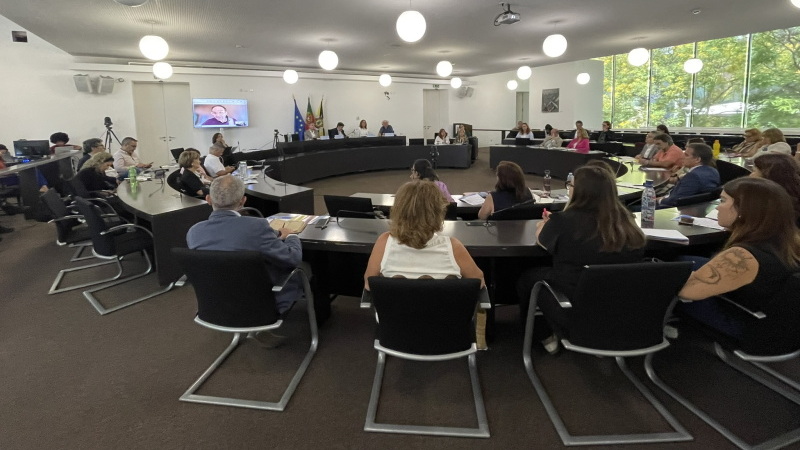
The National Commission for UNESCO, in partnership with the Loures City Council, held a conference in Loures on 19 June entitled "Human Rights and Disinformation – Education as a Response to Manipulation".
This conference aimed to reflect on the impact of disinformation on the exercise of human rights, the quality of public debate, and trust in democratic institutions, also addressing the role of Artificial Intelligence and digital systems in how citizens access information, interpret content, and construct their perception of reality.
Luís Santos, president of the Board of Directors of the Institute for Education, Quality and Evaluation (EduQA), was invited to participate in the thematic panel dedicated to education for informed citizenship, focusing on the current importance of school for the development of cognitive skills that equip young people with a critical spirit so that they are able to ascertain the truth and condemn what is false. In this sense, he recalled that critical thinking is already a concern of school curricula, in line with the reference document "The Student Profile at the End of Compulsory Education". However, it is still important to go further, which involves "having a less academic and more action-oriented curriculum" because, as he stressed, "critical thinking requires action".
The various interventions of this day reinforced the urgency of promoting critical, informed, and participatory citizenship, helping to create more democratic, inclusive, and resilient societies.
The Conference can be reviewed through following link.
Publicado em Jun 29, 2026