
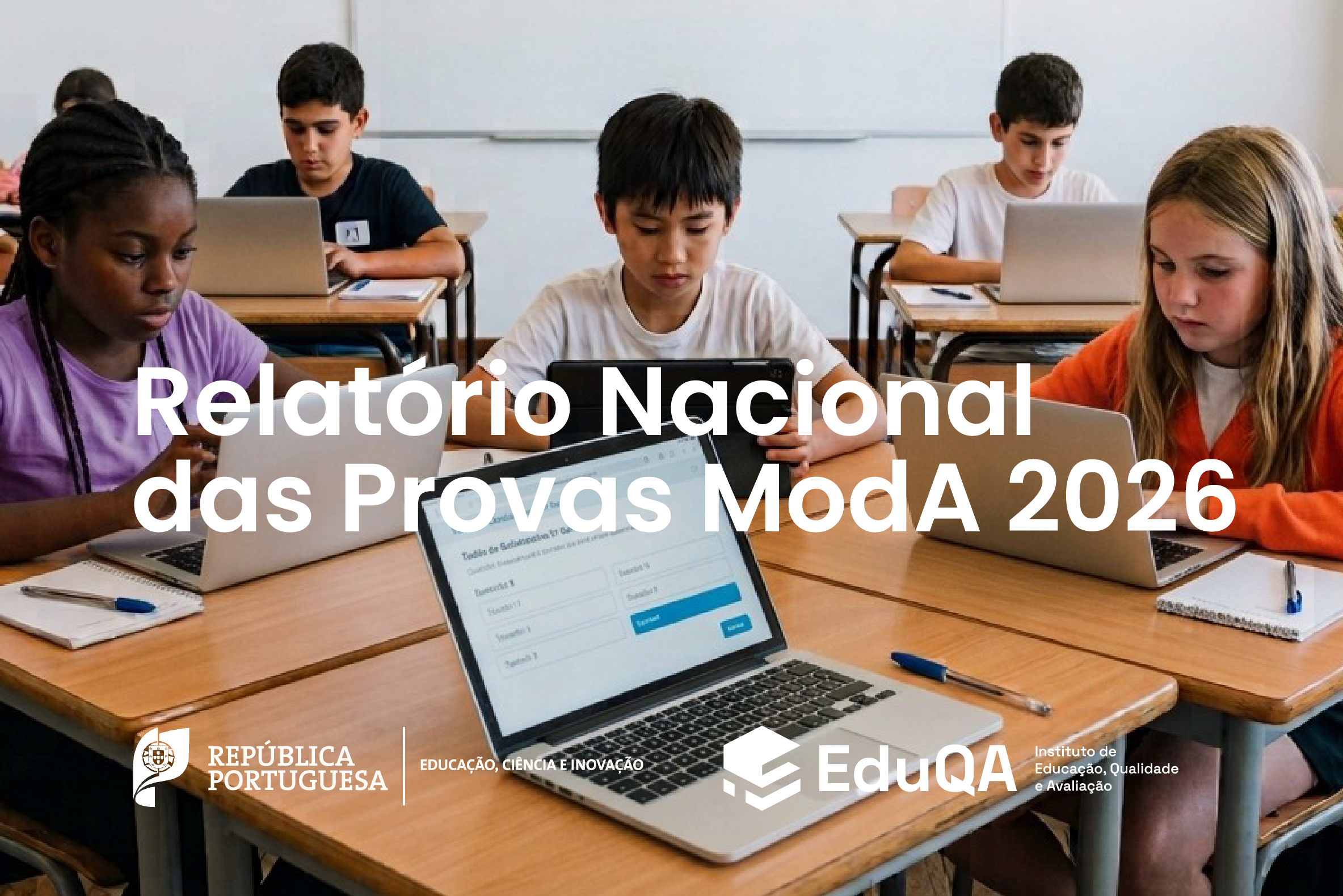
EduQA – the Institute for Education, Quality and Evaluation, IP – provides schools, students and parents/guardians with the results of the Learning Monitoring Tests (ModA) 2026 .
First conducted in 2025, the ModA Tests are an instrument that monitors the evolution of basic education students' learning over the years. In its second edition, which took place in all public and private schools of the 1st and 2nd cycles between May 27 and June 9, 2026, 514,402 tests were carried out, corresponding to 246,073 tests in the 4th grade and 268,329 tests in the 6th grade . The overall completion rates were 80.5% in the 4th grade and 94.4% in the 6th grade, reflecting the high participation in this process, even during a period when strikes occurred.
The 2026 edition allows, for the first time, a comparison of results between two consecutive years of application of the ModA Tests. The results are expressed in ModA Points, on a scale of 0 to 100 that measures student proficiency and not the percentage of correct answers. The national analysis shows slight improvements in several of the literacies assessed, compared to the 2025 results.
In Mathematics, the average ModA score increased from 50.9 to 52.5 points in the 4th grade and from 51.3 to 52.3 points in the 6th grade. In Portuguese, some progress was observed in text production skills, with the average ModA score rising from 47.4 to 50.0 points in the 4th grade and from 45.0 to 47.9 points in the 6th grade. Also noteworthy are the results in Portuguese as a Second Language (PLNM level 2), particularly in interaction and production of written statements, where the average ModA score increased from 43.3 to 55.4 points , and in oral interaction and production, which rose from 46.6 to 52.0 points .
The ModA Tests assess the fundamental skills and literacies foreseen in the Profile of Students Leaving Compulsory Education, providing schools with relevant information to support pedagogical decision-making and the definition of strategies tailored to the realities and needs of students. In 2026, literacies in Portuguese, Mathematics, and Portuguese as a Second Language were assessed, as well as Art Education in the 4th grade and English in the 6th grade, within the framework of the rotating assessment areas model.
The results are made available through reports addressed to schools, students, and parents/guardians. In addition to identifying each student's strengths and areas for improvement, these reports provide comparative information at the school, municipal, and national levels, constituting an important tool to support the monitoring of learning.
The grading of the tests was ensured by EduQA assessment teams, made up of supervising teachers with specialized training and experience in external assessment, contributing to the consistency, reliability, and fairness of the results. The oral production component of the English and Portuguese as a Second Language tests was graded in real time by the teachers from the schools themselves, based on a guide provided by EduQA.
With the release of the results of the 2026 Learning Monitoring Tests , EduQA reinforces its commitment to providing rigorous and useful information for students, families, teachers, schools, and educational policy makers, contributing to the continuous improvement of learning and the quality of the education system.
In summary:
- 514,402 ModA tests conducted nationwide;
- 246,073 tests were taken in the 4th grade and 268,329 tests were taken in the 6th grade;
- First national comparison between the results of 2025 and 2026;
- Slight improvement in average math scores in the 4th and 6th grades, compared to the 2025 results;
- Progress in writing skills in Portuguese and Portuguese as a Second Language (PLNM).
Published in October 20, 2026
