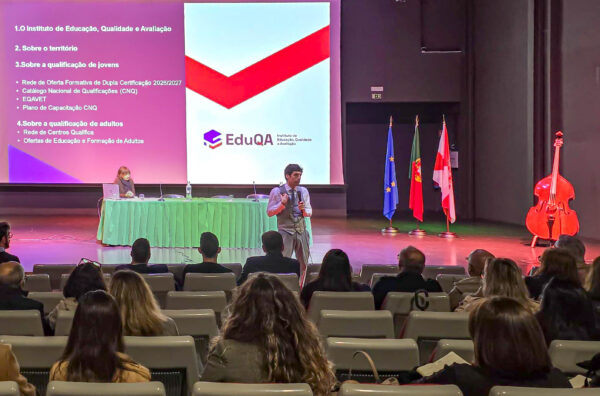
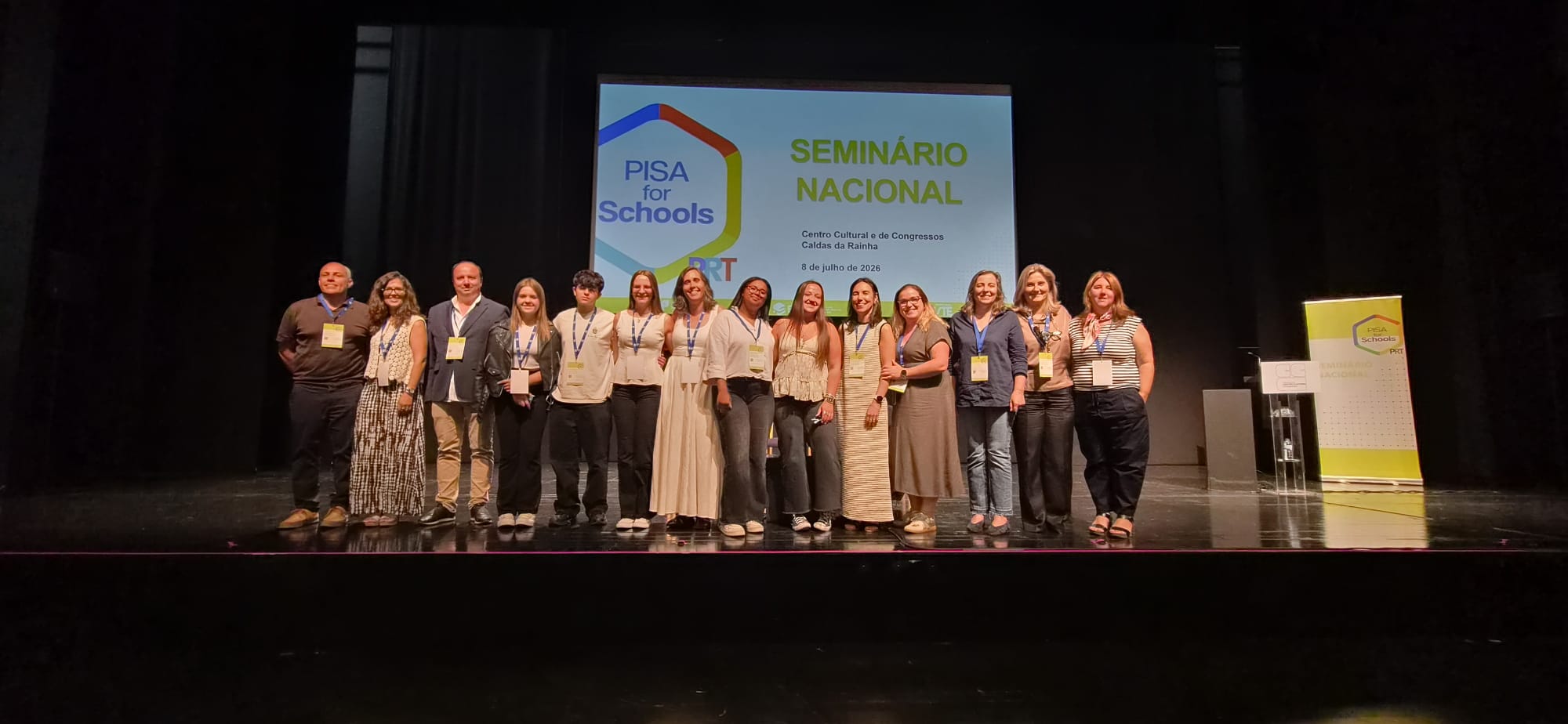
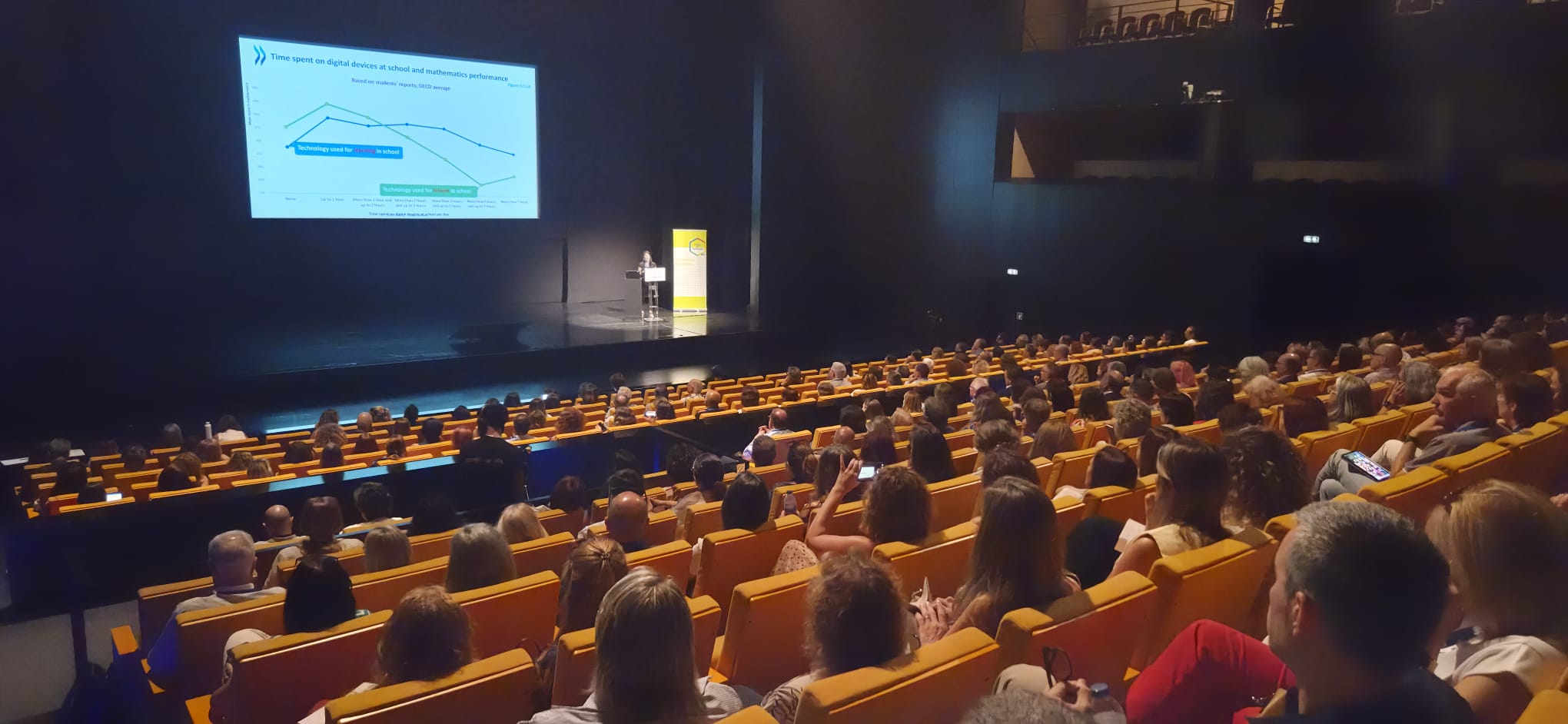
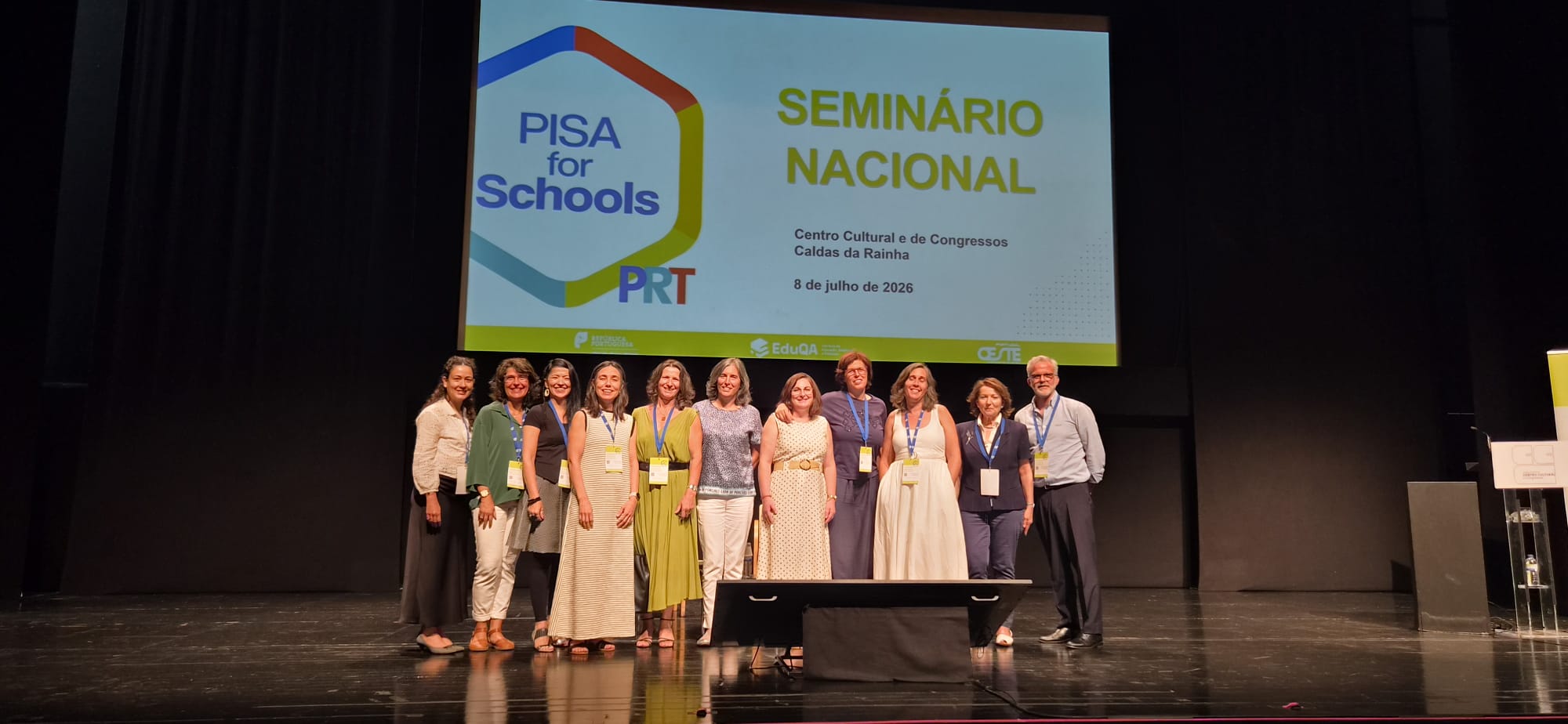
The Caldas da Rainha Cultural and Congress Centre hosted the National PISA for Schools Seminar on 8 July, promoted by the Institute for Education, Quality and Evaluation (EduQA). The event brought together around 300 participants, including OECD representatives, researchers, school principals, municipal and intermunicipal officials, teachers and education specialists, to reflect on the potential of educational data in improving learning and building more sustainable educational policies.
The opening session included speeches by Hermínio Rodrigues, president of the Intermunicipal Council of the West, and Anabela Serrão, member of the Board of Directors of EduQA, who highlighted the importance of collaboration between schools, municipalities and national entities to consolidate a culture of continuous improvement based on the responsible use of educational data.
The first presentation was given by Tanja Vujičić, Senior Analyst at the OECD and head of PISA for Schools, who presented the international evolution of the project and emphasised that the true added value of the assessment lies in the ability of schools to interpret the results, learn from them, and transform them into concrete decisions. The OECD representative also highlighted the growth of the international PISA for Schools community and its contribution to the development of schools that learn in networks and use evidence to improve learning.
The round table discussion “From data collection to results: the experiences of schools” followed, moderated by David Sousa, former Director-General of Education, which brought together Alice Simões (Miraflores School Cluster), Anabela Soares (Arganil School Cluster), Ana Rute Sanguinho (José Régio School Cluster) and Diogo Alves (Conde de Ourém School Cluster). The directors shared the reasons that motivated their participation in the project, reflected on the role of data literacy in school leadership and discussed how PISA for Schools reports can support sustained and collaborative improvement processes.
In her presentation “Learning and Well-being,” Joana Rato, a researcher at the Catholic University of Portugal, presented scientific evidence reinforcing the relationship between learning, well-being, and cognitive development. She highlighted that school environments characterised by trust, security, clarity, and high pedagogical demands simultaneously foster better learning and higher levels of student well-being.
During the afternoon, Luís Tinoca, associate professor at the Institute of Education of the University of Lisbon, focused his presentation on Learning Communities as a driver of educational change. He emphasised that data only gain meaning when analysed within a community and transformed into collective commitment, advocating for professional development models based on collaboration, joint reflection, and the construction of sustainable responses to the challenges identified in schools.
The seminar continued with the round table “Educational Data at the Service of the Territory”, moderated by Margarida Mano, from the Regional Coordination and Development Commission (CCDR) of Lisbon, which brought together António Cunha, Councillor for Education and Knowledge of the Penafiel Municipal Council, and Paulo Simões, Executive Secretary of OesteCIM. The participants highlighted the potential of PISA for Schools data to support the strategic planning of territories, guide local educational policies, strengthen equity and promote greater articulation between municipalities, schools and educational communities.
The conclusions were presented by Marta Procópio, national manager of PISA for Schools, who emphasised that this programme promotes a continuous cycle of evaluation, exploration, and action, placing evidence at the service of pedagogical and organisational decisions that contribute to improving learning and summarising the central message of the seminar: “Data that inspires. Schools that transform.”
The National PISA for Schools Seminar also benefited from the active collaboration of students from the Cister de Alcobaça School Cluster, responsible for welcoming the participants, the Rafael Bordalo Pinheiro School Cluster, from Caldas da Rainha, which provided audiovisual coverage of the event, and students from the Caldas da Rainha Vocational Dance School, in conjunction with the Raul Proença School Cluster, also from Caldas da Rainha, who performed the artistic segment of the opening session.
By bringing together different perspectives - international, academic, school-based, and territorial - the National PISA for Schools Seminar reinforced an idea that ran through all interventions: data, by itself, does not transform schools; it is decisions based on their interpretation that make possible a more consistent, collaborative, and sustainable educational improvement.
Published in July 30, 2026