Saltar para o conteúdo principal

Public body responsible for quality, curricular innovation and external evaluation of learning in the Portuguese education system.

Roma Culture, History and Education in the Portuguese Context

Formadores de pé junto ao ecrã de projeção e participantes sentados em mesas em formato de U na segunda edição do curso sobre Cultura, história e educação Roma/cigana.

The second edition of the training course Roma Culture, History and Education in the Portuguese Context took place in 17-18 April and 8-9 May 2026, in Figueira da Foz, and was funded by the project RomaMemory. This training course was a partnership between the Council of Europe/Roma and Travellers Division and the joint European Union and Council of Europe project Equality and Freedom from Discrimination for Roma: Roma Holocaust Remembrance and Education (RomaMemory), the Ministry of Education, Science and Innovation/Institute for Education, Quality and Evaluation, P.I. (EduQA, I.P.) and the University of Minho. Roma Culture, History and Education in the Portuguese Context is a trainers training course, which aims to prepare trainers at Teacher Training Centres (CFAE) to facilitate the training in their regions (mainland Portugal).

This was a 25-hour face-to-face training course facilitated by the Council of Europe trainers Maria José Casa-Nova (coordinator), Maria Alfredo Moreira (both Professors at University of Minho), Bruno Gonçalves and Cláudio Garcia (both Roma activists and mediators). The training course aimed to strengthen trainers’ knowledge about the culture and history of the Roma people, both nationally and at European level, to emphasise the importance of getting to know each child/pupil in order to enhance their academic success, and to highlight the importance of implementing high-quality inclusive practices centred on human rights and fundamental values. It also intended to raise awareness about the Council of Europe’s recommendations in this area, share teaching practices that foster the inclusion and educational success of Roma children and young people, and develop tools that help implementing an intercultural conceptual approach.

Publicado em Jun 08, 2026
Notícias Relacionadas

Logótipo do Instituto de Educação, Qualidade e Avaliação, constituído por um símbolo geométrico tridimensional à esquerda e o nome EduQA à direita.
May 27, 2026

Survey of students taking the ModA and PFEB 2025/2026 exams.

Within the framework of the Learning Monitoring Tests (ModA) and the Final Basic Education Tests (PFEB) to be carried out in the 2025/2026 school year, the Ministry of Education, Science and Innovation (MECI) will promote the application of a brief anonymous questionnaire to students after they have taken the respective tests in digital format.

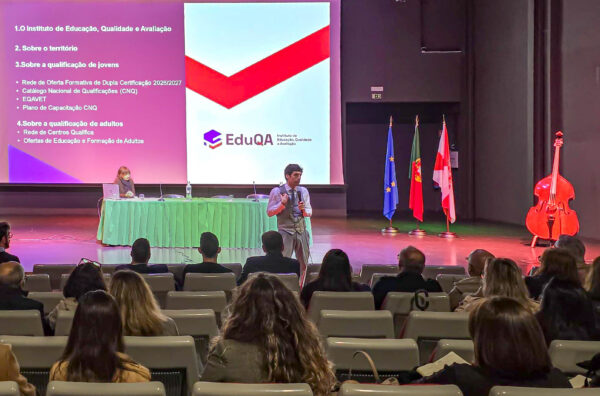
O vogal do Conselho Diretivo do EduQA falando aos participantes.
March 30, 2026

EduQA promotes regional sessions with vocational schools.

Guilherme Rocha, a member of the Board of Directors of EduQA, IP and responsible for the areas of Qualifications and Lifelong Learning, is conducting a series of regional sessions with school clusters and vocational schools across the country. The first session took place in Viseu on March 19th. [Further sessions followed...]

ubbu 2026
September 29, 2026

ubbu: project to teach programming and computational thinking will be available again in 2026/2027

Ubbu is an online platform with the social mission of preparing all children for the new digital society through the teaching of Computer Science and Programming. It aims to contribute to positioning Portugal at the forefront of the development of computational thinking and digital literacy among students in the 1st, 2nd, and 3rd cycles of Basic Education in public schools. In 2026/2027, the platform will reinforce the content of Artificial Intelligence and Cybersecurity, broadening the scope of digital literacy worked on in the classroom.