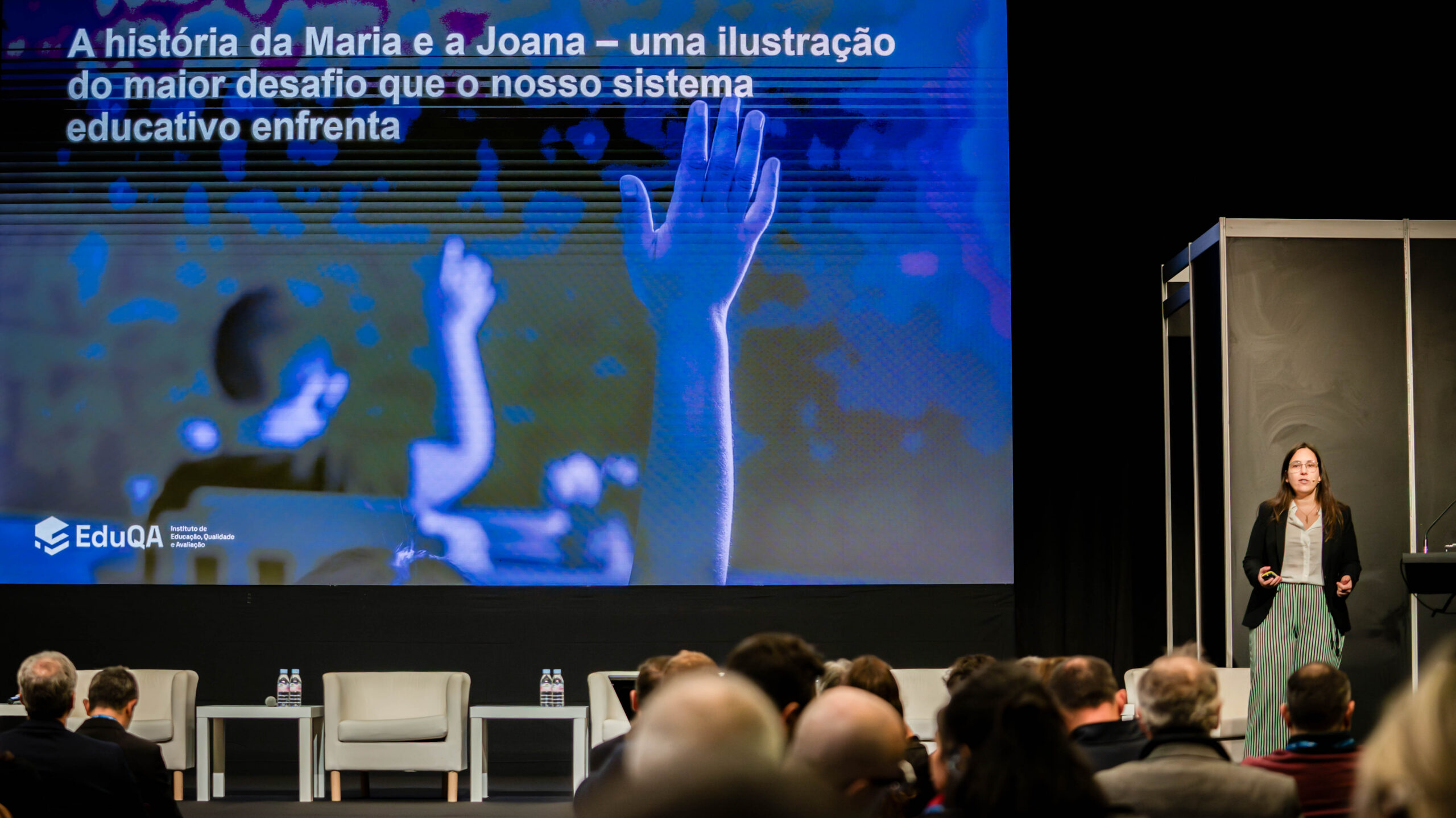
 “Educating and learning in the age of Artificial Intelligence” was the theme of a conference that included the participation of Rebeca Sá Couto, member of the Board of Directors of EduQA, IP, at TECH_EDU, a parallel event to Futurália, which took place at FIL, in Lisbon, from 11 to 13 March.
The digital transition of education in Portugal was the focus of this edition of Futurália, the largest education and vocational training fair in the country.
In her speech, Rebeca Sá Couto sought to place the debate on artificial intelligence (AI) within the issue of educational inequalities, arguing that the main challenge lies in understanding how this technology can contribute to ensuring access to quality education for all students.
To illustrate this idea, she used the story of Maria and Joana, two children with different socioeconomic backgrounds: while Maria has access to AI tools, Joana does not. In this context, AI acts as a learning accelerator in one case, but produces no effect in the other, which could translate, by the end of their schooling, into very different levels of development.
Rebeca Sá Couto also added to the narrative the figure of teacher Luísa, who uses AI tools in the teaching-learning process to mitigate these inequalities, pointing out that this will be one of the main challenges of the education system.
The Minister of Education, Science and Innovation, who closed the conference, also argued that AI is a technology that teachers cannot ignore. He warned of the risk of worsening inequalities if equal access is not ensured, further emphasising the growing importance of digital skills in the labour market.
Fernando Alexandre also argued that the use of artificial intelligence in school administration will optimise processes and "eliminate the disadvantages of a highly centralised system," as part of a reform he intends to complete by the end of 2027.
Publicado em March 23, 2026